
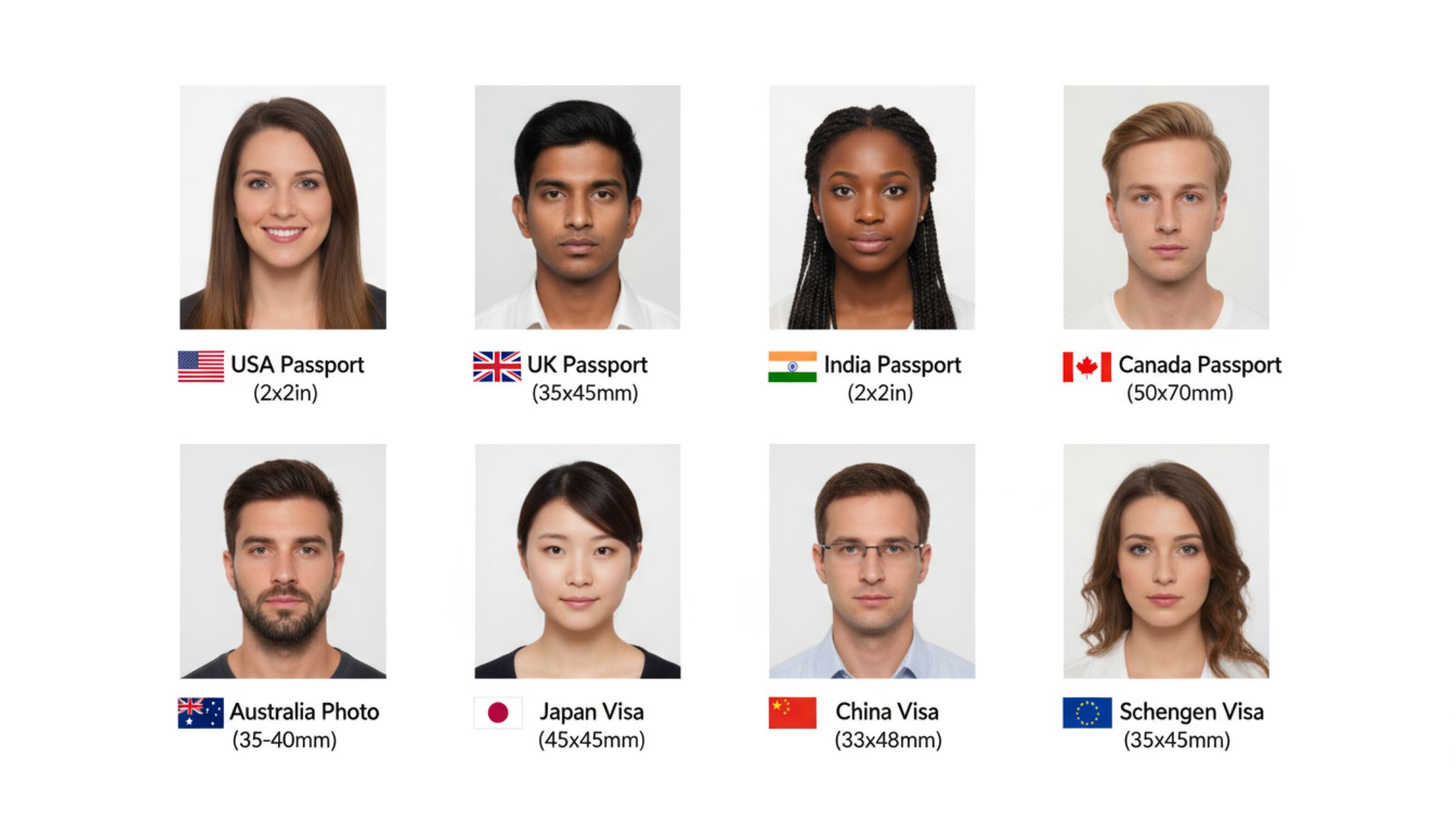
Getting your passport or visa application approved might feel straightforward—just fill out forms, pay the fee, and submit a photo, right? Well, not exactly. One of the most overlooked yet critical details is the photo size. A small misstep here can lead to delays, extra costs, or even outright rejection. Let’s dive into why following the correct photo size is non-negotiable and what can go wrong if you don’t.
The Role of a Passport and Visa Photo
You might think a passport or visa photo is just a simple snapshot of your face, but in reality, it serves as a critical tool for global identification. This small image carries a lot of responsibility—it’s essentially the visual representation of your identity for official authorities. Every detail, from your facial expression to the proportions of your head in the frame, is scrutinized to ensure it matches the person applying. A photo that is slightly off in size, lighting, or clarity can raise doubts about your identity, potentially causing your application to be delayed or even rejected. In many ways, the photo is the first line of defense against misidentification, fraud, or unauthorized travel.
Identity verification is the most crucial function of your passport and visa photo. Immigration officers rely heavily on this image to match your appearance with your documents. It’s not just about recognizing your face at a glance; authorities need to see clear, measurable features such as the distance between your eyes, the shape of your nose, and the contours of your jawline. A photo that is too small, too large, or poorly cropped can distort these features, making it difficult to confirm your identity. Inaccurate photos can lead to repeated questioning, additional documentation requests, or even outright rejection of your application.
Modern travel security also depends on digital systems, particularly facial recognition technology, which has become a standard at airports and border checkpoints. These systems analyze multiple facial points to match your photo with your actual appearance. If your passport or visa photo doesn’t meet exact size and cropping specifications, the software may fail to recognize you. This failure can trigger manual inspections, increasing processing times and causing unnecessary stress for travelers. Even minor deviations in photo dimensions, like a slightly larger head size or uneven cropping, can disrupt these automated checks.
In addition to technology-based checks, manual reviews still play a significant role. Border officers and consular staff often examine photos with a fine-tooth comb, comparing them with previous records or biometric data. A single error in photo size, angle, or background can draw attention and create doubts about authenticity. Essentially, your passport and visa photo is a bridge between you and the authorities, ensuring a smooth verification process. Getting it right the first time not only saves you from headaches but also ensures your travel plans proceed without unnecessary obstacles.
Official Requirements for Photo Sizes
Following the correct photo size is absolutely crucial because different countries have strict rules, and ignoring them is one of the most common reasons for passport or visa rejection. Even small deviations in size, head position, or background color can lead to delays, additional fees, or outright denial of your application. To make things easier, here’s a detailed list of the official photo requirements for passports and visas across various countries:
- United States (USA): Standard passport photos must be 2 x 2 inches, with the head size between 1 inch and 1 3/8 inches from the bottom of the chin to the top of the head. The background must be plain white or off-white, ensuring your face is clearly distinguishable. Lighting should be uniform to avoid shadows.
- United Kingdom (UK): Passport photos in the UK should measure 35 x 45 mm, with the head size ranging from 29 to 34 mm. The background must be light grey, and the face must be centered and evenly lit. Glasses should not obscure the eyes, and no hats or head coverings are allowed unless worn for religious purposes.
- India: Indian passport photos are 2 x 2 inches, with the head occupying 1 inch to 1 3/8 inches. The background must be plain white, with no shadows or textures. The face must be clearly visible, eyes open, and mouth closed. These specifications are strict, as even minor deviations can cause the application to be rejected.
- Canada: Canadian passport photos must measure 50 x 70 mm, with the head size between 31 and 36 mm. The background must be plain white, and the photo should be printed on high-quality photo paper. Facial features must be clearly visible without any glare, shadows, or tinted lenses.
- Australia: Passport photos in Australia should be 35–40 mm in width, with a head height between 32–36 mm. The background must be plain white, and the face should be evenly illuminated. Facial expressions should be neutral, with eyes open and mouth closed.
- Japan: For visa photos, Japan requires a 45 x 45 mm image with the head proportion carefully centered. The face must take up most of the frame, and the background should be plain, ideally white. Correct proportions are critical to avoid rejection.
- China: Visa photos for China must be 33 x 48 mm, with a full-face view. The background should be plain and light-colored, typically white. Facial features must be clear, without shadows, glasses reflections, or any obstruction.
- Schengen Countries (Europe): Most Schengen visa applications require photos sized 35 x 45 mm, with the head height properly aligned within the frame. Backgrounds must be plain light-colored, typically white or light grey. Facial expression should be neutral, and the head centered and fully visible.
Consequences of Incorrect Photo Sizes
| Consequence | Description | Cause | Impact on Traveler | Estimated Cost/Delay |
| Application Rejection | The most immediate consequence is that your application can be rejected outright. | Photo size too small, too large, or improperly cropped. | Wasted time and money; need to start the application process from scratch. | Loss of application fee ($30–$200 depending on country); weeks of delay. |
| Processing Delays | Even if initially accepted, incorrect photos often slow down processing. | Minor deviations in head size, incorrect background, or poor quality photo. | Travel plans may be postponed; additional follow-ups required. | Delays of 1–4 weeks; possible missed flights or appointments. |
| Manual Verification | Photos that fail automated checks require manual review by staff. | Incorrect dimensions or improper digital format. | Extra scrutiny at immigration or consulate; longer wait times. | 1–2 weeks added to processing time; increased stress. |
| Additional Costs | Fixing mistakes can incur extra charges. | Resubmitting photos, reprinting, or using expedited services. | Financial burden and repeated trips to photo studios or consulates. | $50–$100 extra for reprints and processing fees. |
| Travel Disruption | In worst-case scenarios, incorrect photos can prevent you from traveling. | Rejected visas or delayed passports. | Missed flights, canceled bookings, and lost opportunities. | Potentially hundreds of dollars in travel disruptions and lost reservations. |
Common Mistakes to Avoid
One of the most frequent mistakes travelers make is using the wrong photo dimensions. Many assume that any standard “passport-sized” photo will suffice, but each country has strict requirements regarding width, height, and head proportions. Even a small deviation—like a few millimeters too large or too small—can result in your application being rejected. This is particularly true for digital submissions, where software algorithms are designed to detect precise dimensions. The key is to always verify the official photo size requirements for the country you are applying to, and to measure your photo carefully before submission.
Another common pitfall is improper head size within the photo. Even if the overall dimensions are correct, the proportion of your head in the frame must match specific guidelines. A head that is too small can make your facial features hard to identify, while a head that is too large can be cropped awkwardly, leaving important features like the chin or hairline out of frame. This mistake is surprisingly common because many travelers focus solely on the photo’s outer dimensions and overlook the internal proportions. Ensuring the head occupies the recommended portion of the photo frame is essential for both manual and automated verification processes.
Background errors are another frequent source of problems. Some countries strictly require a plain white background, while others may allow a light grey shade. Using patterned, dark, or colored backgrounds can trigger automatic rejections. Shadows, textures, or reflections in the background can also create issues for facial recognition software. A simple, uniform background ensures your face stands out clearly and prevents unnecessary delays. It may seem like a minor detail, but immigration authorities often treat this as a non-negotiable standard.
Finally, low-resolution or blurry photos are a surprisingly common issue. Even if your photo has the correct size and head proportions, poor quality images can fail automated facial recognition or appear unacceptable to human reviewers. Low-resolution images may obscure details like the contours of your face or the shape of your eyes, which are critical for identification. Always ensure your photo is sharp, well-lit, and printed or saved at a high resolution. This small attention to quality can save you weeks of delays and the stress of re-submitting your application.
Technical Tips for Correct Photo Size
Ensuring your passport or visa photo meets all official requirements is essential to avoid delays or rejections. Paying attention to technical details can save time, money, and stress. Here’s a detailed list of actionable tips to get your photo right the first time:
- Use a professional photographer – Professionals are trained to meet the strict specifications of each country. They know exactly how to capture the correct head size, overall photo dimensions, lighting, and background color. A skilled photographer can also advise on proper facial expression and posture, ensuring the photo complies with all standards.
- Verify official photo guidelines online – Every embassy, consulate, or government website provides specific photo requirements, including dimensions, head size, background color, and digital resolution. Download official templates or reference images if available to ensure your photo meets exact specifications. This step eliminates guesswork and ensures compliance.
- Use high-quality digital tools for resizing and cropping – If you choose to take a photo yourself, software like Adobe Photoshop, GIMP (free), or online passport photo editors can help you adjust the dimensions and crop the image precisely. These tools allow you to fine-tune head size, alignment, and spacing within the frame, preventing common mistakes like oversized or undersized heads.
- Ensure proper lighting and clarity – Even with the correct dimensions, poor lighting can create shadows or obscure facial features. Natural, even lighting is ideal, and the face should be fully visible without glare. High-resolution photos (minimum 300 dpi) help ensure your facial features are clearly captured, which is critical for both manual and automated checks.
- Pay attention to background – Use a plain, light-colored background (white or light grey) as required by the country you are applying to. Avoid patterned, textured, or colored backgrounds, as these can trigger rejections. The background should be uniform with no shadows, reflections, or objects visible.
- Double-check photo alignment and proportions – The face must be centered in the frame, with eyes at the correct height and head occupying the recommended portion of the photo. Even slight misalignment or off-center positioning can result in your photo being rejected.
How Facial Recognition Systems Influence Photo Size
| Aspect | Description | Why It Matters | Potential Issue if Incorrect | Impact on Traveler |
| Proper Scaling | Facial recognition software analyzes key facial landmarks, including eyes, nose, mouth, and head shape. | Ensures the system can accurately map facial features for verification. | If the photo is too small or too large, the software cannot detect or align facial features properly. | Automatic verification fails, requiring manual review and delaying application processing. |
| Head Position & Proportion | The head must occupy the correct portion of the frame and be centered. | Proper proportion allows software to distinguish your face from the background and measure distances between facial points. | Misaligned or improperly sized head may be rejected by the system. | Extra scrutiny from immigration officers; possible delays at checkpoints. |
| Background Uniformity | A plain, light-colored background ensures clear contrast between the face and surroundings. | Improves facial recognition accuracy by reducing noise or distractions. | Patterned or colored backgrounds can confuse automated systems. | Manual review needed; may trigger requests for resubmission. |
| Photo Resolution | High-resolution images capture all necessary facial details. | Enables accurate detection of facial features like eyes, nose, and mouth. | Low-resolution or blurry photos prevent proper feature extraction. | Delays in processing and potential rejection; must provide a better-quality photo. |
| Lighting & Shadows | Even lighting ensures no part of the face is obscured. | Critical for software to identify features correctly. | Shadows or uneven lighting can distort facial landmarks. | May cause verification errors, manual inspections, and application delays. |
Passport vs. Visa Photos: What’s the Difference?
At first glance, passport and visa photos might seem identical, but there are important differences that travelers need to understand. Passport photos are generally designed to meet standardized guidelines for your home country, ensuring that the image works across multiple official documents, including passports, ID cards, and sometimes even driver’s licenses. These photos must follow strict rules for dimensions, head size, lighting, and background color to maintain consistency and avoid any ambiguity when used domestically or internationally.
Passport photos are often subject to a uniform set of specifications, which makes them relatively straightforward to obtain. Most countries require specific head proportions, proper alignment, and a neutral facial expression. The lighting and background must also adhere to official guidelines, usually a plain white or light-colored background with no shadows. Because these photos are valid for multiple uses within the issuing country, ensuring accuracy at the first attempt is crucial, as even minor errors can lead to delays or rejection of your passport application.
Visa photos, on the other hand, are frequently country-specific and can differ significantly from passport photo requirements. While some countries adopt the same standards as passport photos, others require unique dimensions, specific backgrounds, or stricter rules regarding head positioning and expression. For example, some countries may insist on slightly larger head sizes, particular pixel resolutions for digital submissions, or even guidelines for shoulder visibility. These requirements are tied to entry approval in foreign countries, so a visa photo must be tailored precisely to the destination country’s specifications.
Additionally, the purpose of these photos differs. Passport photos serve as a domestic identification tool, linking your face to official records within your home country. Visa photos, however, act as a gateway for international travel, allowing foreign authorities to verify your identity before granting entry. Because of this, even small mistakes in a visa photo—such as incorrect dimensions, improper background, or poor lighting—can result in application delays, resubmissions, or even denials. Understanding the distinctions between passport and visa photos ensures travelers submit compliant images, reducing the risk of unnecessary stress and complications during international travel.