
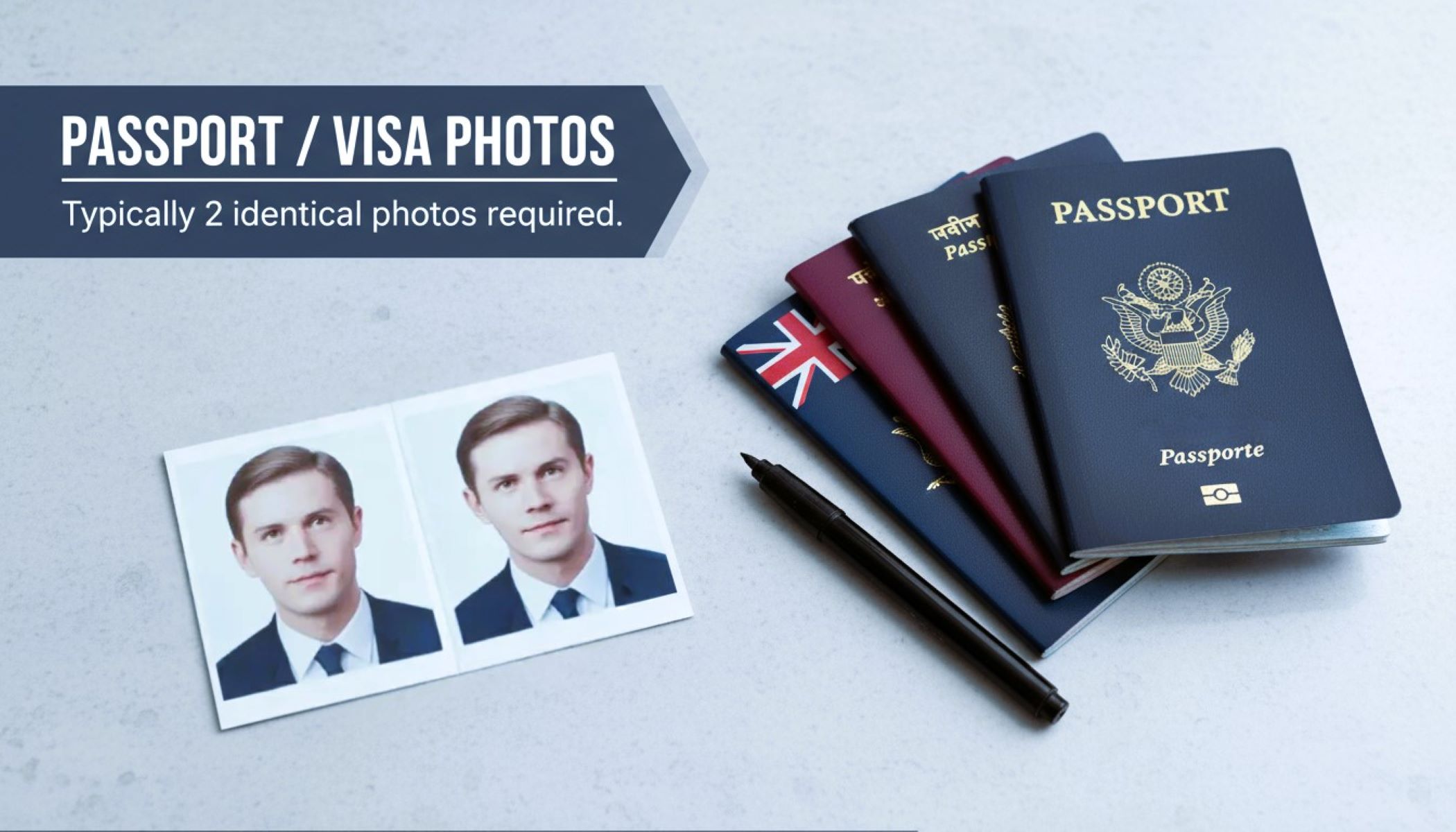
Applying for a passport or visa can be confusing. One of the most common questions people ask is, “How many photos do I actually need?” It might seem trivial, but getting this detail wrong can delay your application. In this article, we’ll break it all down: from the number of photos required for different countries to tips on ensuring your photo meets official standards.
Understanding Passport and Visa Photo Requirements
Before we dive into numbers, it’s essential to understand why photo requirements exist. Passport and visa photos are not just a formality—they are a critical part of your identification and security verification. Every country follows specific guidelines to ensure that the image is clear, consistent, and suitable for official documents. Even a minor deviation, such as the wrong background color or a slight tilt of the head, can result in your application being delayed or rejected, which could cause unnecessary stress and extra expenses. These rules exist to maintain a universal standard that immigration and border officials can rely on to quickly and accurately verify your identity.
The specifications cover multiple aspects of the photograph, from size and resolution to background color and facial expression. For example, most countries require a plain, light-colored background, ensuring that the applicant’s face stands out clearly. Proper lighting is crucial to avoid shadows that can obscure facial features, and the image must be sharp enough for biometric analysis. Additionally, authorities often require the applicant to have a neutral expression with both eyes open and mouth closed, eliminating the chance of distorted recognition by automated systems or human officers.
Beyond the technical details, photo requirements also serve as a security measure. High-quality, standardized photos help prevent identity fraud, counterfeiting, and illegal entry attempts. They allow border control officers to quickly identify individuals and compare them with existing records or travel databases. This is especially important for visas, where applicants might be coming from multiple countries with varying security risks. Following photo guidelines precisely reduces the likelihood of errors that could trigger additional verification checks, saving both time and resources for travelers and authorities alike.
Lastly, understanding these requirements can also make the application process smoother and less stressful. Many applicants underestimate how strict these rules can be, assuming that a casual snapshot will suffice. In reality, compliance with photo standards ensures that your application proceeds without unnecessary delays. Knowing the details beforehand—such as the correct number of photos, dimensions, and acceptable attire—gives you confidence that your passport or visa application meets all necessary criteria. It’s a small step that can make a big difference in avoiding headaches and ensuring that your travel plans stay on track.
Why Passport and Visa Photos Are Important
| Importance | Purpose | How It Works | Potential Issues if Ignored | Tips for Compliance |
| Identity Verification | Confirms the applicant’s identity to authorities | Photos are compared against government databases, biometric systems, and previous travel records | Using an incorrect photo can lead to delays, additional verification, or application rejection | Use a clear, recent photo with a neutral expression and both eyes open |
| Security Measures | Prevents fraud and identity theft | Standardized photos allow officials to quickly spot inconsistencies or falsified documents | Low-quality or outdated photos can compromise security and trigger further checks | Ensure photo quality is high and follows country-specific guidelines for size, background, and resolution |
| Global Recognition | Ensures photos are universally acceptable | Follows international standards like ICAO 9303, which define dimensions, face positioning, and other technical requirements | Non-compliant photos may be rejected by foreign consulates or border agencies | Check the ICAO-compliant standards for your destination country before taking photos |
| Smooth Travel Experience | Reduces delays at visa processing and border control | Proper photos enable faster approval and reduce chances of administrative issues | Incorrect or poor-quality photos can stall visa approval or cause travel delays | Always carry extra sets of photos in case of last-minute requirements or rejection |
| Official Documentation | Maintains consistent identity records across passports and visas | Photos become part of your official records, used for renewals, multiple-entry visas, or biometric checks | Mismatched or low-quality photos can create confusion in future applications | Follow photo specifications exactly, including recent updates, to avoid future discrepancies |
Standard Passport Photo Requirements
- Most countries have specific rules for passport photos, but they generally follow similar international standards to ensure clear identification.
- The size of passport photos varies depending on the country, and using the wrong dimensions can lead to rejection. For example, in the USA, the standard photo size is 2 x 2 inches (51 x 51 mm), while in the UK, it is 45 x 35 mm. India follows 51 x 51 mm, Australia uses 35 x 45 mm, and the Schengen Area requires 35 x 45 mm photos. Always check the exact requirements for your destination country before taking or printing your photos.
- The background of the photo must be plain and light-colored, typically white or off-white, without any patterns or objects that can distract from your face. This ensures that your facial features are clearly visible and that the photo can be processed digitally if needed. Shadows or uneven lighting can also result in rejection, so proper lighting is essential.
- Your facial expression should be neutral, with your mouth closed and eyes fully open. Avoid smiling, frowning, or making exaggerated expressions. The goal is to have a clear, natural representation of your face that matches you exactly at the time of travel.
- The head and shoulders must be fully visible, centered in the frame, and occupy the majority of the image. Your face should typically take up 70–80% of the photo’s height. Cropping or incorrect positioning can make the photo invalid.
- Accessories such as hats, sunglasses, or headphones are generally not allowed unless for religious or medical reasons. Hair should not cover your eyes or face, and glasses must not reflect light or obscure the eyes.
- Clothing should contrast with the background, ideally wearing darker or neutral colors to ensure that your face stands out clearly. Avoid uniforms or overly bright patterns that can interfere with photo processing.
- The photo must be recent, usually taken within the last six months, to reflect your current appearance accurately. Using old photos may result in rejection, especially if your appearance has changed significantly.
- The photo must be high-resolution, sharp, and not pixelated or blurry. Printing quality matters, and it should be on photo paper if submitting a physical application. Matte or glossy finishes are generally acceptable, depending on the country.
How Many Passport Photos Are Needed?
When applying for a passport, one of the first questions many travelers ask is how many photos they actually need. The number can vary depending on the country and the type of passport being issued, but most countries require two identical photos for adults. For instance, in the United States, passport applicants must submit two identical 2 x 2-inch photos with their application. Similarly, in the United Kingdom, two recent photos are required for new adult passports, while Australia also mandates two photos, with the additional requirement that they are signed on the back by a referee. India typically requires two photos for adults, while children under the age of five may need two or more, depending on the application type and specific guidelines.
Carrying an extra set of photos is always a good idea. Even if you meet all the requirements perfectly, photos can sometimes get damaged, smudged, or rejected due to minor technicalities such as slight background shadows, incorrect lighting, or subtle facial expression issues. Having one extra set on hand can save you from delays or the need to retake photos at the last minute. Think of it as a small investment in convenience—losing a few minutes to check your extra set is far better than risking an application delay that could set back your travel plans by weeks.
For passport renewals, the rules are generally similar to those for new applications. Most countries ask for the same number of photos as the original passport application. However, some countries may require fewer photos for renewals if your previous passport already has a recent photo on file. It’s important to check the official guidelines of the issuing country, as minor differences in regulations can occur depending on age, citizenship, and whether the passport is being renewed for a minor or an adult. Following the exact specifications ensures a smooth process without additional verification steps.
Finally, understanding and preparing the correct number of photos can greatly simplify the passport application process. It’s not just about meeting the requirement; it’s about avoiding unnecessary delays, additional fees, and repeated trips to a photo studio or government office. By keeping the right number of high-quality, compliant photos ready, you ensure that your application proceeds efficiently, making the entire experience more stress-free and predictable. A little preparation upfront can save a lot of headaches later.
Visa Photo Requirements
| Country/Region | Number of Photos | Size (mm) | Specific Requirements | Tips for Compliance |
| USA | 2 identical photos | 51 x 51 | Photos must be recent (within 6 months), neutral expression, full-face view | Avoid shadows, wear neutral clothing, ensure high resolution and proper lighting |
| Schengen Area | 2 recent photos | 35 x 45 | Face should occupy 70–80% of photo height, neutral expression, both eyes open | Use a plain white background, ensure proper lighting, and check for digital or print format specifications |
| UK | 2 identical photos | 45 x 35 | Background must be plain cream or light grey, neutral expression, full head and shoulders visible | Avoid hats, glasses with reflections, or facial coverings; make sure the photo is recent |
| India | 2–3 photos depending on visa type | 51 x 51 | Recent photos required, neutral expression, head centered and fully visible | Children may require additional photos; ensure proper contrast with background and high-quality print |
| Australia | 2 identical photos | 35 x 45 | Head and shoulders visible, plain background, neutral expression | Sign the back if submitting printed photos, avoid shadows or glare, follow exact dimensions |
Special Cases: Children and Infants
- When applying for passports or visas for children, photo requirements are generally more flexible than for adults, but accuracy and clarity are still crucial.
- Infants and toddlers often require special handling to ensure their face is clearly visible while following official standards.
- For very young children, the head may be supported during the photo, but the supporting hands must not be visible in the frame. This ensures the child’s face remains unobstructed and suitable for identification purposes.
- Eyes should ideally be open, but some countries allow minor exceptions for infants who cannot keep their eyes open. It is important that even with minor deviations, the facial features are clearly visible and centered.
- The number of photos for children usually follows the standard adult requirement of two, but in some countries or for certain visa types, three or four photos may be requested, especially for infants under the age of one.
- Lighting is particularly important when photographing children; harsh lighting or strong shadows can obscure facial features or make the photo non-compliant. Soft, even lighting is recommended, preferably from natural sources or professional photo studio setups.
- The background must be plain and uncluttered, typically white or light-colored, to provide maximum contrast with the child’s face and prevent distractions in the image.
- Clothing should be light-colored to ensure the face stands out clearly against the background. Avoid patterned outfits or uniforms that can interfere with photo recognition systems.
- Ensure that the child is positioned straight on, with the face centered in the frame. The head should take up the majority of the image without being cropped at the top, and shoulders should be visible for proper proportion.
- Photos must be recent, generally taken within the last six months, to reflect the child’s current appearance. Rapid growth or changes in facial features can render old photos invalid.
- Even small details matter: avoid toys, blankets, or pacifiers in the photo unless explicitly allowed by the issuing authority. Every element that covers or obscures the face can result in rejection.
- Parents should prepare extra sets of photos, as children may move, blink, or be difficult to photograph perfectly on the first try. Having additional copies ensures that applications are not delayed due to minor imperfections.
- Following these guidelines carefully ensures that children’s passport and visa applications proceed smoothly, preventing repeated trips to photo studios or government offices for retakes.